Introduction: The Search That Happens Without a Screen
It is seven-thirty on a Tuesday evening in Mumbai. Priya is driving home after a long day and realises she has forgotten to pick up a birthday cake for her mother. She does not pull over to search Google. She does not open Maps. She simply speaks: 'Hey Siri, find me a bakery near me that is still open.'
Siri responds within three seconds. One business. One recommendation. No list of ten options. No page of links. Just a single answer: the name of a bakery, its closing time, a star rating, and directions — all spoken aloud without Priya ever touching her phone.
Real-World Voice Scenario
"Hey Siri, find me a bakery near me that is still open."
Siri responds within three seconds: "I found Baker's Delight, about 800 metres away on Main Road. They are open until 9:00 PM today with a 4.8-star rating."
Did your bakery make that answer? Or did your competitor's?
This is the reality of voice search in 2026 — and it is happening millions of times a day across India. Commuters in Bengaluru asking Google Assistant for the nearest affordable gym. Parents in Delhi asking Alexa for a good paediatrician nearby. Tourists in Jaipur asking Siri which heritage hotel has the best reviews. In every one of these moments, an AI assistant makes a single recommendation — and a business either wins the customer or loses them, often without ever appearing on a screen at all.
Voice and AI assistant search is growing faster in India than almost anywhere else in the world, driven by the explosion of affordable smartphones, the rollout of high-speed mobile internet, and the extraordinary comfort Indian users have developed with voice interaction in regional languages. And yet the overwhelming majority of Indian local businesses have done almost nothing to prepare for it.
This guide will explain exactly how voice search and AI assistants work, how they decide which business to recommend, why that single recommendation matters more than any ranked list, and — most importantly — the precise steps your business needs to take to become the answer when a customer speaks.
Section 1: How Voice Search Is Different — And Why It Demands a Different Strategy
One Answer, Not Ten
The fundamental difference between voice search and typed search is this: typed search returns a list; voice search returns an answer. When you type 'best dermatologist Koramangala' into Google, you receive a page of results — ten organic links, a map pack, several ads, and perhaps an AI Overview. You have options. You can compare. You can click through.
When you ask Google Assistant 'Who is the best dermatologist near me in Koramangala?', the assistant gives you one answer. Perhaps two, if the query is ambiguous. But there is no page of results. There is no scrolling. The AI makes a recommendation on your behalf, and that recommendation is typically the end of the search journey. The customer either visits the recommended business or rephrases and searches again.
This creates a fundamentally different competitive dynamic. In typed search, ranking third or fourth is still valuable — you will still receive clicks and visits. In voice search, third place is invisible. The business that wins the voice recommendation wins the customer. Everything else is silence.
The Fundamental Shift in Local Search
Traditional SEO was about getting found. Voice SEO is about being chosen. Traditional SEO targeted short keyword fragments. Voice SEO targets full conversational questions, intent, and verified business data.
The Indian Voice Search Reality
India has become one of the world's largest and fastest-growing voice search markets, for several interconnected reasons. Smartphone penetration has reached into smaller cities and rural areas where typing in English has always been a barrier — but speaking in Hindi, Tamil, Telugu, Kannada, or any other regional language is entirely natural. Google Assistant and Siri both support major Indian languages, and voice queries in regional languages are growing rapidly.
Beyond language, there is a practical convenience driver: millions of Indians commute daily in conditions where looking at a phone is impractical or dangerous — on a two-wheeler, navigating traffic, or in a crowded Metro. Voice search is not a novelty in these contexts; it is a necessity. And when someone speaks a search query while commuting, they are typically at or near the moment of decision — ready to act on whatever the AI recommends immediately.
The Voice Search Stakes for Local Business
A customer who types a search query is browsing. A customer who speaks a voice query is deciding.
The intent behind voice searches is significantly more immediate and action-oriented than typed searches. Studies consistently show that a higher proportion of voice searches result in same-day visits or purchases compared to equivalent typed searches. Being the business an AI assistant recommends to a voice searcher is not just a visibility win — it is a conversion win.
Section 2: Meet the Four AI Assistants Recommending (or Ignoring) Your Business
There are four major AI assistants that Indian smartphone and smart device users interact with regularly. Each one has its own data sources, its own strengths, and its own tendencies when generating local business recommendations. Understanding all four is essential for a comprehensive voice search strategy.
| Google Assistant | Apple Siri | Microsoft Copilot | Amazon Alexa |
|---|---|---|---|
| Powers Android phones, Google Maps, Nest devices | Powers iPhones, iPads, Mac computers | Embedded in Windows, Microsoft Edge, Bing search | Smart speakers, Fire tablets, Alexa-enabled devices |
| Primary source: Google Business Profile | Primary source: Apple Maps (Yelp in US, local data in India) | Primary source: Bing Places, web content, Microsoft data | Primary source: Yelp (limited India coverage), web data |
| Most used in India — dominant on Android | Growing fast as iPhone penetration rises in urban India | Significant share via Windows laptops and Edge browser | Limited India footprint but growing with smart speakers |
| Optimise: Google Business Profile is non-negotiable | Optimise: Apple Maps listing, review quality | Optimise: Bing Places profile + website content | Optimise: Website structured data, web authority |
For most Indian local businesses, Google Assistant carries the largest share of voice search traffic by a significant margin, given Android's dominance in the Indian smartphone market. However, as iPhone adoption grows in urban India — particularly among the upper-middle income demographic that many service businesses target — Siri's importance is increasing rapidly and should not be neglected.
Example: Well-Optimized Google Business Profile
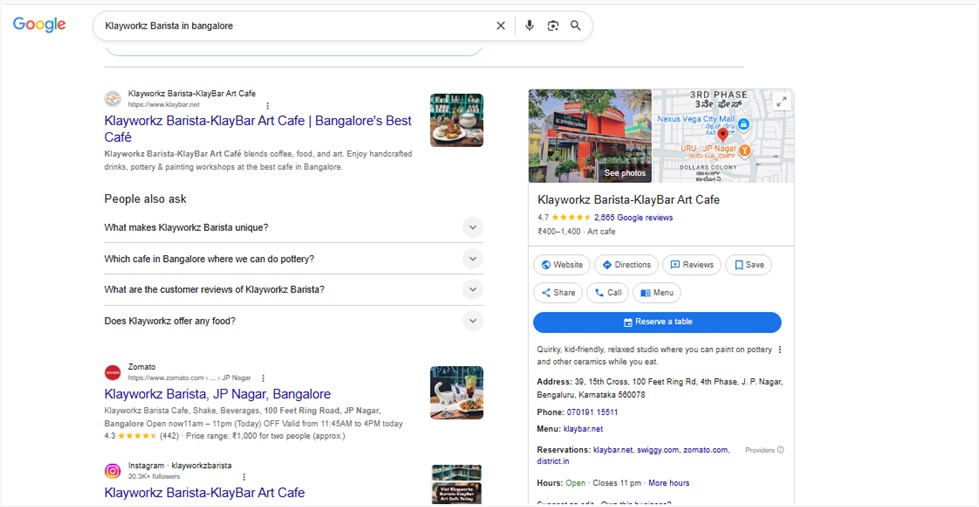
Figure 2.1: Google Business Profile of Klayworkz Barista–KlayBar Art Café displaying customer ratings, reviews, business hours, address, contact information, website, directions, and photos.
Why this is a good example
This Google Business Profile is fully optimized with complete business information, customer reviews, business hours, website link, contact details, and high-quality photos. These are the primary signals Google Assistant uses to understand and recommend local businesses for voice search queries.
Section 3: What AI Assistants Look For When Choosing a Business to Recommend
AI assistants do not make random recommendations. They follow a consistent — if not fully transparent — set of criteria when selecting which business to name in response to a voice query. Understanding these criteria gives you a clear roadmap for becoming the recommended choice.
Criterion 1: Proximity — How Close You Are to the Searcher
For local queries, proximity is always a primary factor. 'Near me' is the most common qualifier in local voice searches, and AI assistants take this literally. A business two kilometres away from the searcher will be favoured over one six kilometres away, all else being equal. This means that ensuring your location data is precisely accurate — your Google Business Profile address, your Apple Maps listing, your Bing Places location — is the starting point for voice search visibility.
Criterion 2: Relevance — How Clearly Your Business Matches the Query
AI assistants match voice queries to businesses based on how clearly and completely the business communicates what it does. A bakery that lists 'custom birthday cakes, wedding cakes, and anniversary cakes' in its service descriptions will be far more likely to surface for the query 'find me a birthday cake bakery near me' than one whose GBP description simply says 'We sell baked goods and confections.'
This relevance matching extends to the language used in your reviews. If multiple customers have reviewed your bakery mentioning 'birthday cakes', 'custom designs', and 'same-day orders', the AI assistant associates your business with those specific terms and is more likely to recommend you when a voice query includes those concepts.
Criterion 3: Prominence — How Trusted and Well-Known Your Business Is
Prominence is Google's term for the overall credibility and authority of a business in its local market. For AI assistants, prominence is assessed through a combination of factors: the volume and quality of reviews, the number and consistency of mentions across external websites, the completeness and activity level of your business profile, and the overall strength of your digital footprint. A business with 150 reviews and active weekly posts reads as a thriving, well-known establishment. A business with 8 reviews and a profile last updated two years ago reads as marginal or uncertain.
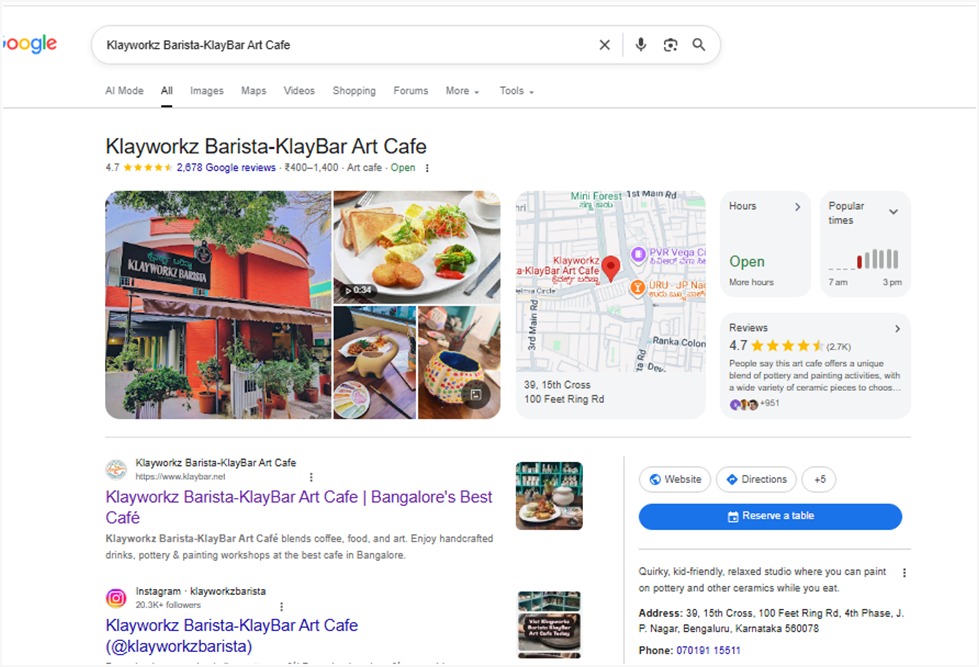
Figure 3.1: Example of a high-prominence Google Business Profile with strong customer ratings, review volume, complete business information, and active customer engagement.
Why this is a good example
This profile demonstrates how a business with a high rating, a significant number of reviews, and complete business details appears more trustworthy to Google Assistant and other AI assistants when generating local voice search recommendations.
Criterion 4: Recency — Whether Your Business Appears Currently Active
AI assistants are particularly attentive to signals of current activity. They are, after all, answering a real-time question — the customer wants to visit a business today, not a business that may or may not still be operating. Businesses with recent reviews, recent photos, recent Google Posts, and accurate current hours send strong signals of active, ongoing operation. Those whose profiles appear dormant — regardless of their actual trading status — are less likely to be confidently recommended.
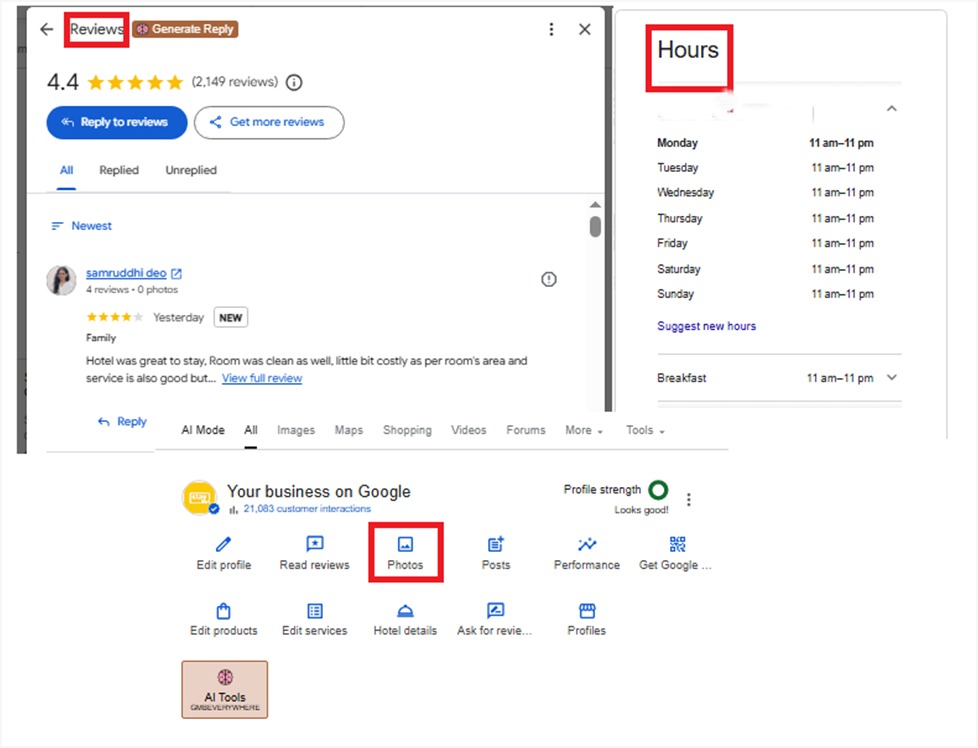
Figure 3.2: Google Business Profile displaying recent Google Posts, updated photos, current business hours, and recent customer reviews.
Why this is a good example
This Google Business Profile demonstrates ongoing business activity through recent Google Posts, updated photos, active customer reviews, and accurate operating hours. These freshness signals help Google Assistant and other AI assistants identify the business as active and reliable, increasing its chances of being recommended for voice search queries.
Criterion 5: Accurate and Complete Business Information
Perhaps the single most critical factor — and the most commonly overlooked — is the completeness and accuracy of your basic business information. Hours of operation are particularly important for voice search: when someone asks 'Is there a pharmacy near me open right now?', an AI assistant can only include your business in the answer if your opening hours are correctly listed and current. A business with inaccurate hours is not just unhelpful — it is actively harmful to the AI's ability to make confident recommendations.
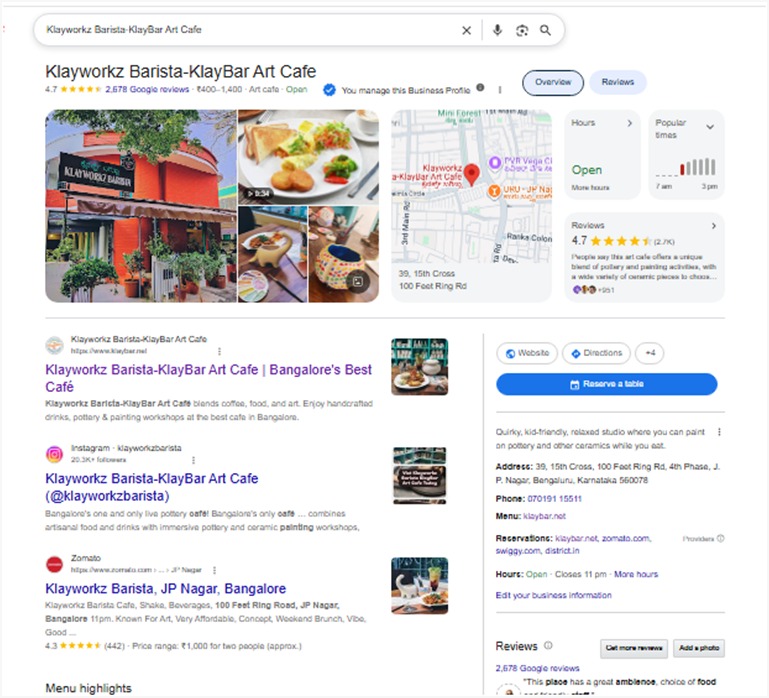
Figure 3.3: Google Business Profile of Klayworkz Barista–KlayBar Art Café displaying complete business information, including business hours, address, phone number, website, customer ratings, and directions.
Why this is a good example
This Google Business Profile provides complete and accurate business information, including operating hours, address, phone number, website, customer ratings, and navigation details. These details help AI assistants confidently answer voice queries such as "Is this café open now?", "Call Klayworkz Barista", or "Get directions to Klayworkz Barista."
Section 4: Real Voice Queries — What AI Assistants Say About Your Business Type
To make this concrete, here are examples of real-world voice queries in each of the four major assistant ecosystems, showing the kind of answer they generate and what determines which business is named.
Google Assistant — Android Phone, Bengaluru
User: Hey Google, find me a good orthopedic surgeon near Indiranagar who takes appointments quickly.
AI Response: I found Orthocare Clinic on 12th Main Road, Indiranagar — they are open until 8 PM today, rated 4.8 stars from 134 reviews. Reviewers mention short waiting times and experienced doctors. Would you like directions or to call them?
Apple Siri — iPhone 15, Chennai
User: Siri, which saree shop in T. Nagar has the best reviews and is open today?
AI Response: Ananya Collections on Pondy Bazaar Road has 4.8 stars from 61 reviews and is open until 9 PM. Would you like to call them or get directions?
Microsoft Copilot — Windows Laptop, Mumbai
User: Find me a highly rated tax consultant in Andheri West who specialises in GST for small businesses.
AI Response: Based on available information, TaxSmart Advisory in Andheri West is well reviewed for GST compliance services for small businesses. Their website includes detailed information on GST registration, filing, and audit support.
Notice the pattern across all three examples: the AI assistant names a single business, provides a specific reason to trust it (rating, review count, what reviewers say), gives actionable information (hours, location), and offers a next step. The business that wins the recommendation is the one the AI can describe most specifically and confidently — not necessarily the biggest or the most established, but the most legible.
Section 5: The Complete Voice Search Optimisation Checklist
Voice search readiness is not a single action — it is the sum of several interconnected optimisations across your digital presence. The checklist below covers every significant factor, organised by platform and priority.
For Google Assistant (Priority 1 — Highest Impact for Indian Businesses)
- Verify and complete your Google Business Profile in full — category, description, all services, all attributes.
- Ensure your opening hours are accurate for every day of the week, including current special hours for public holidays.
- Build your review profile to a minimum of 50 genuine reviews — actively request them from satisfied customers via WhatsApp.
- Publish at least one Google Post per week to signal active, current operation.
- Upload fresh photos monthly — interior, exterior, team, and service/product shots.
- Populate your Q&A section with the most common questions customers ask before visiting — including location-related questions like parking availability.
- Implement LocalBusiness schema markup on your website with precise address, hours, and category data.
For Apple Siri (Priority 2 — Growing Importance in Urban India)
- Claim and optimise your Apple Maps listing at mapsconnect.apple.com — this is the primary data source for Siri's local recommendations.
- Ensure your Apple Maps listing shows the same name, address, hours, and category as your Google Business Profile.
- Build reviews on platforms that feed into Siri's data — in India, this currently includes general web authority signals and Google reviews that Siri increasingly cross-references.
- Ensure your website loads quickly on mobile — Siri's web-browsing capability means mobile performance directly affects Siri search outcomes.
For Microsoft Copilot (Priority 3 — Particularly Relevant for B2B and Professional Services)
- Create and verify a Bing Places for Business listing at bingplaces.com — this is Copilot's primary local business data source.
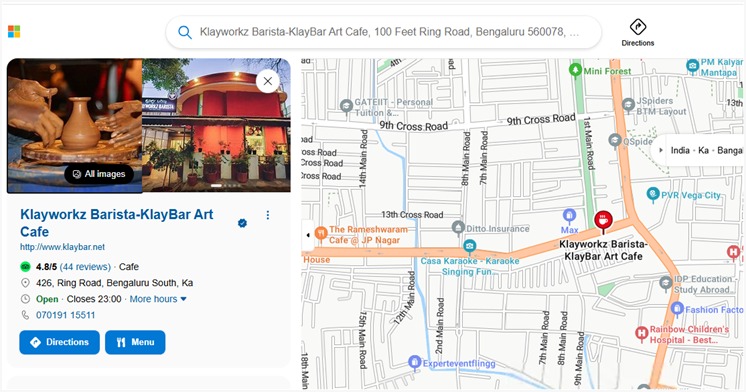
Figure 5.3: Bing Maps listing of Klayworkz Barista–KlayBar Art Café displaying verified business information, including location, contact details, website, business hours, and customer reviews.
Why this is a good example
This Bing Maps listing provides accurate and up-to-date business information that Microsoft Copilot can use when recommending local businesses. A complete Bing listing strengthens a business's visibility across Bing Search, Bing Maps, and Microsoft Copilot.
- Ensure your website content is rich, comprehensive, and well-structured — Copilot draws heavily from website content when GBP-equivalent data is thin.
- Implement schema markup on your website, as Copilot's web crawling is responsive to structured data signals.
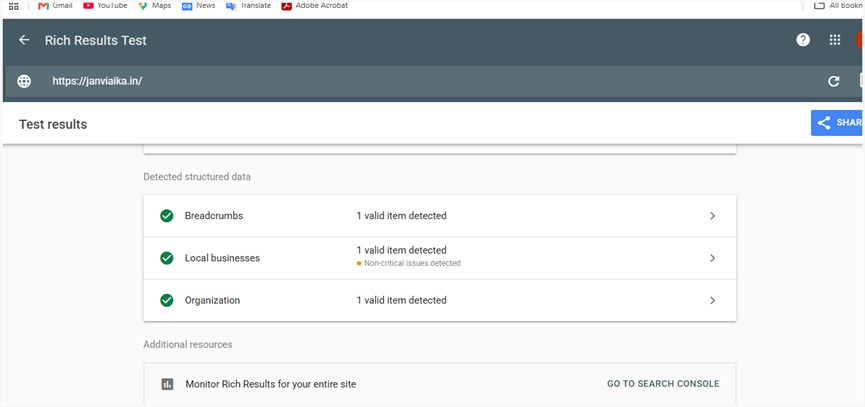
Figure 5.4: Google Rich Results Test showing valid LocalBusiness, Organization, and Breadcrumb structured data implementation on the Janvi Aika website.
Why this is a good example
This Rich Results Test confirms that the website has successfully implemented valid LocalBusiness, Organization, and Breadcrumb schema markup. Structured data helps search engines and AI assistants accurately understand essential business information such as the business name, location, and website structure, improving visibility in local search and AI-powered recommendations.
Content Optimisation for All Assistants
- Write your website content in natural, spoken language — the same way you would answer a question out loud, not the way you would stuff keywords into a paragraph.
- Include 'near me' equivalent phrases in your content naturally: 'If you are looking for a trusted accountant in Koramangala...' rather than attempting to literally use the phrase 'near me.'
- Ensure every service page directly answers the questions someone might ask about that service in a voice query: what it costs, how long it takes, who it is for, what to bring.
- Include your city and neighbourhood name naturally throughout your website — not forced, but as part of genuinely local content.
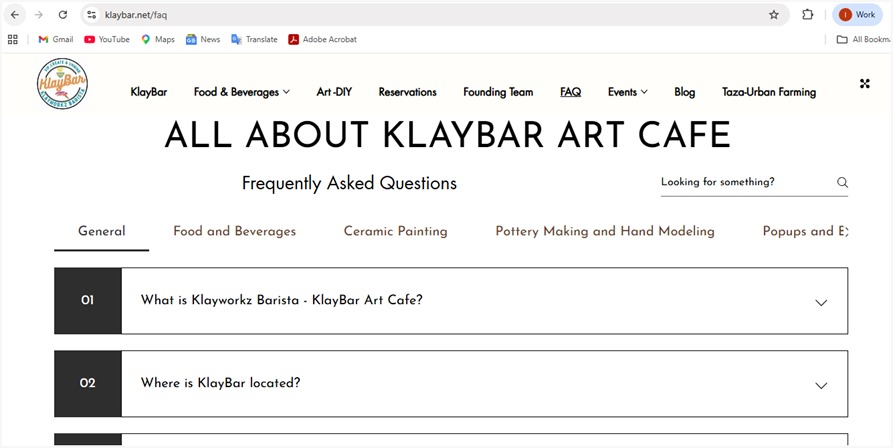
Figure 5.1: Klayworkz Barista's FAQ page organizes customer questions into clear categories and provides structured information that helps AI assistants understand and answer common user queries.
Why this is a good example
This FAQ page is structured around real customer questions, making it easier for AI assistants such as Google Assistant, Siri, Microsoft Copilot, and Alexa to understand the business and provide accurate answers for voice search queries.
Section 6: Case Study — A Jaipur Hotel That Started Appearing in Siri Recommendations
The Business: Haveli Heritage Stays, Old City, Jaipur
Haveli Heritage Stays is a boutique heritage hotel in Jaipur's Old City area, offering twelve traditionally decorated rooms in a restored 19th-century haveli. The property is genuinely beautiful, its reviews on booking platforms are consistently excellent, and it has attracted a loyal base of domestic and international guests who return for the authentic Rajasthani experience.
However, the hotel had almost no independent digital presence beyond its listings on OYO, MakeMyTrip, and Booking.com. It had no Google Business Profile, no Apple Maps listing, no standalone website, and — crucially — was completely invisible to AI assistants when tourists in Jaipur or arriving travellers asked their phones for hotel recommendations.
The most painful version of this problem was Siri. A significant proportion of Haveli's international guests arrived in India with iPhones, and many of them used Siri to find accommodation or restaurants near their current location. Despite being arguably the most characterful boutique property in the Old City, Haveli Heritage Stays simply did not exist in Siri's world.
The Transformation
- A standalone website was built for the property — six pages covering the hotel, the rooms, the location, nearby attractions, the food, and a booking page. Every page was written in warm, specific, conversational language designed for both human readers and AI discovery.
- A Google Business Profile was created, verified, and fully completed — including the specific category 'Heritage Hotel,' a 700-character description emphasising the property's history, atmosphere, and unique guest experience, photo uploads across all twelve rooms, and accurate hours and contact details.
- An Apple Maps listing was claimed and optimised through Maps Connect, mirroring the GBP information precisely.
- A Bing Places listing was created for Copilot visibility.
- LocalBusiness and LodgingBusiness schema markup was implemented on the website, explicitly identifying the property as a heritage hotel in Jaipur's Old City with structured data covering room types and amenities.
- The hotel began actively requesting reviews from guests at checkout — a WhatsApp message with a direct Google review link sent to every Indian guest, and a verbal request to international guests to leave a Google or TripAdvisor review before departing.
The Outcome
Within four months, Haveli Heritage Stays went from zero AI assistant presence to appearing regularly in voice search responses for queries like 'heritage hotel in Jaipur old city' and 'best boutique hotel near Hawa Mahal.' Three separate guests in a single month mentioned discovering the property specifically through Siri when arriving at Jaipur Airport. The hotel's direct booking enquiries — through its own website rather than through OYO or MakeMyTrip — grew significantly, reducing their dependence on commission-heavy third-party platforms.
Case Study Results — Haveli Heritage Stays
The owner, Rajesh, noted that the entire digital setup process — building the site, creating the profiles, implementing schema — cost a fraction of one month's OYO commission fees, and the return in terms of direct bookings and AI visibility made it the best marketing investment the property had ever made.
The Lesson for Every Local Business
You do not need to be on every platform and every app to be found by voice search. You need to be correctly, completely, and consistently present on the specific platforms that AI assistants draw their data from. For most Indian businesses, that means Google Business Profile first, Apple Maps second, and a well-structured website throughout.
Voice search does not reward the most advertised business. It rewards the most legible one.
Section 7: Voice Search in Indian Regional Languages — The Emerging Frontier
One of the most important and least-discussed dimensions of voice search in India is the rapid growth of regional language queries. Google Assistant now supports Hindi, Tamil, Telugu, Kannada, Bengali, Marathi, Gujarati, and several other Indian languages for voice search — and usage in these languages is growing faster than in English.
This creates both a challenge and an opportunity for local businesses. The challenge: most business websites and GBP listings are written exclusively in English, which means the content may not be as well-matched to regional language queries as it could be. The opportunity: businesses that begin optimising for regional language voice search right now are entering a space where competition is almost nonexistent.
| Voice Search in English | Voice Search in Regional Languages |
|---|---|
| High competition — most businesses optimise for this | Low competition — very few businesses optimise for this |
| AI matching well-established and competitive | AI matching rapidly improving, less saturated |
| Primarily urban, higher-income demographics | Tier 2/3 cities + vernacular-comfortable metro users |
| Google and Siri both handle well | Google Assistant leading; Siri improving |
| Most current content and GBP data in English | Huge opportunity: be among the first in your category |
Practical steps for regional language voice search readiness include adding your Google Business Profile description in both English and your primary local language, creating at least some website content in regional language (or ensuring your site renders correctly when translated by the browser), and specifically including your city name in regional language script in your online listings where supported.
Conclusion: Prepare for the Search That Happens Without a Screen
The way people find local businesses is changing — not slowly and gradually, but rapidly and irreversibly. The typed search with ten blue links is giving way to the spoken question with one spoken answer. The customer browsing options is giving way to the customer acting on a recommendation. And the business that wins is no longer the one at the top of a ranked list — it is the one whose name the AI says out loud.
For Indian local businesses, this shift is both a challenge and a remarkable opportunity. The challenge is real: voice search readiness requires deliberate, multi-platform optimisation that most businesses have not yet undertaken. The opportunity is equally real: because most businesses have not yet undertaken it, those that do — right now, in 2026 — can establish a voice search presence in their local market before their competitors even understand the concept.
The businesses that will dominate voice search recommendations in the months and years ahead are not the ones with the deepest pockets or the most sophisticated marketing teams. They are the ones that made sure their information was complete and accurate, their reviews were rich and genuine, their profiles were active and current, and their websites were written in the same natural language that real customers use when they speak.
The next time a potential customer speaks to their phone looking for exactly what you offer, will your business be the answer?