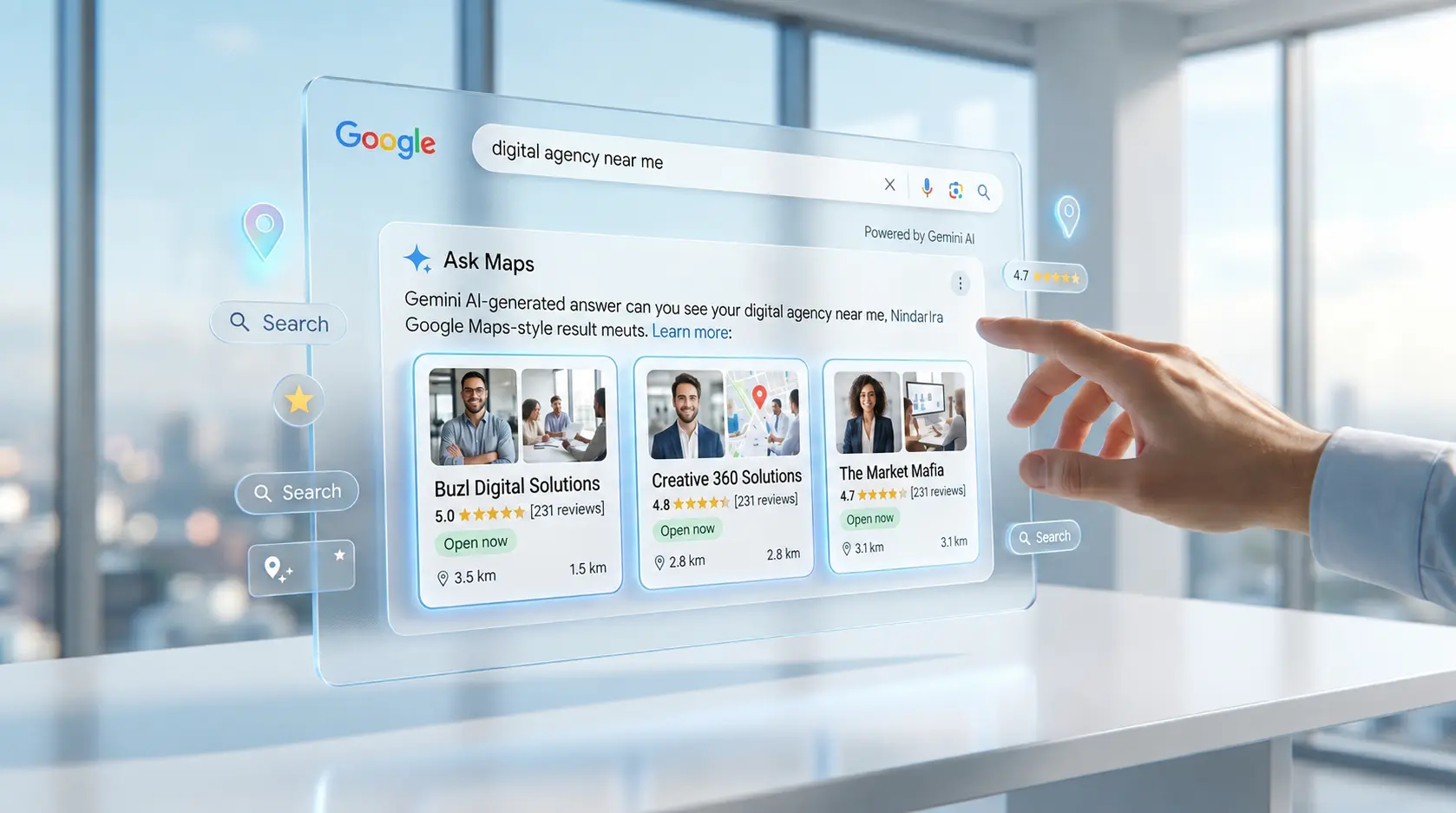
Why Your Business Doesn't Appear in AI Answers (And How to Fix It)
Introduction: The Silent Shift No One Warned You About
Picture this: A potential customer sits down, opens their laptop, and types a question into an AIpowered search tool — maybe it's Google's AI Overviews, Microsoft Copilot, or ChatGPT. They ask something like, 'What is the best marketing agency for small businesses in my city?' With in seconds, the AI responds with a confident, well-structured answer - listing specific businesses, explaining what they do, and even recommending a first step to take. Your business is not mentioned. Not even once.
This scenario is no longer a distant future concern — it is happening right now, every single day, to thousands of businesses around the world. And here is the unsettling truth: you may not even know it is occurring, because unlike traditional search rankings, there is no dashboard telling you how many times an AI skipped over your name. We are living through one of the most significant transitions in the history of digital marketing. For the past two decades, businesses have invested heavily in search engine optimization (SEO) — crafting keyword-rich content, building backlinks, and optimising meta descriptions — all in pursuit of that coveted first-page position on Google. That strategy worked brilliantly, and many businesses built entire revenue streams around it. But the rules have changed. AI-powered search tools no longer just return a list of ten blue links. Instead, they read, interpret, and synthesise information from across the web to generate a single, direct, conversational response. And in that response, there are no page two results — there are only the businesses the AI chooses to mention, and the ones it does not. The question, then, is not just 'How do I rank on Google?' The question is: 'How do I become the business that AI recommends?
This guide is designed to answer exactly that. We will explore why AI search tools work the way they do, diagnose the most common reasons businesses are invisible to them, and give you a practical, actionable roadmap to change that.
Section 1: Understanding How AI Search Actually Works
From Links to Language: The Fundamental Change
To understand why your business might be absent from AI answers, you first need to understand how AI search tools are fundamentally different from traditional search engines.
Traditional search engines like Google (pre-AI Overviews) operated on a relatively straightforward principle: crawl billions of web pages, index their content, and return the most relevant links based on a user's query. Users then clicked through those links to find their answers. The engine was a librarian pointing you to books — it was up to you to do the reading.
AI-powered search tools operate on an entirely different model. They do not just point to information — they read it, understand it, and generate a synthesised response on your behalf. Tools like ChatGPT, Google Gemini, Microsoft Copilot, and Perplexity AI use large language models (LLMs) trained on massive datasets of text from the internet, books, databases, and other sources. These models learn to understand context, nuance, relationships between concepts, and — critically — trustworthiness.
When a user asks an AI tool a question, the model draws on everything it has been trained on (and in some cases, live web data it retrieves in real time) to compose an answer. It is not selecting from a list of ten options; it is writing a response. And in writing that response, it will only reference sources and businesses it considers relevant, credible, and well-understood.
The Credibility Filter: Why AI is Selective
AI models are not random. They have developed what we might call a credibility filter — an implicit judgement about which sources are trustworthy enough to cite and which businesses are well-defined enough to recommend.
This filter is built from patterns in training data. If a business has been written about extensively by credible publications, mentioned positively in expert forums, described consistently across multiple platforms, and associated with clear, specific expertise — the AI has enough information to understand what that business does and trust it enough to mention it. If a business exists only on its own website, has thin content, inconsistent descriptions, or has never been mentioned by any external source, the AI simply does not have enough reliable information to confidently reference it.
Think of it this way: if you asked a highly knowledgeable friend to recommend a great Italian restaurant in your city, they would only recommend places they have heard about from multiple trustworthy people. A restaurant that no one has ever mentioned, reviewed, or written about would never cross their lips — not because it is bad, but because it does not exist in their knowledge base
Key Insight: How AI Decides Who to Mention AI tools recommend businesses they 'know well' — and they know businesses through the volume, quality, and consistency of information available about them across the web. The more credibly and clearly your business is described across authoritative sources — third-party websites, industry directories, news articles, expert reviews, and structured data — the more likely an AI is to understand, trust, and recommend you.Section 2: The Six Most Common Reasons Your Business Is Invisible to AI
Now that we understand how AI search tools think, let us diagnose the most likely reasons your business is not appearing in their answers. Based on current research and industry analysis, the following six factors are the most common culprits.
Reason 1: You Have Not Established Topical Authority
AI search tools are designed to answer specific questions from people with specific needs. They look for businesses and sources that are genuinely expert in a particular area — not generalists who cover everything at a surface level.
If your website content is broad, scattered across too many topics, or lacks genuine depth on any single subject, the AI will not associate your brand with authority in any specific domain. You may cover everything, but you are seen as the expert in nothing.
Example: Consider two accounting firms. Firm A has a website with a general page about 'Accounting Services,' a brief blog post about tax season, and a contact page. Firm B has published thirty in-depth articles about small business tax planning, a comprehensive guide to VAT for e-commerce companies, a podcast series on financial planning for startups, and has been quoted in three industry publications as an expert in small business finance. When someone asks an AI tool 'What accounting firm is best for my small e-commerce business?' — Firm B will almost certainly be mentioned. Firm A likely will not.
The lesson here is not just to produce more content — it is to produce deeply expert content in a focused niche, consistently over time, in a way that signals clear and specialised knowledge.
Reason 2: You Have Little or No Third-Party Presence
One of the most significant factors in AI visibility is what others say about you — not what you say about yourself. AI models are, by design, sceptical of self-promotion. A business that only appears on its own website, talking about how great it is, does not carry much weight.
What AI tools are looking for is corroboration — independent confirmation from credible sources that your business exists, does what it claims to do, and does it well. This includes mentions in industry publications, guest articles on reputable websites, reviews on trusted platforms like Google, Trustpilot, or industry-specific directories, podcast appearances, and news coverage.
If your digital footprint consists almost entirely of your own website and social media profiles you control, the AI has very little external evidence to draw on — and very little reason to trust or cite you.
Reason 3: Your Online Information Is Inconsistent or Contradictory
AI systems are built to synthesise information from multiple sources. But when different sources say different things about your business — different addresses, different descriptions of what you do, different phone numbers, conflicting information about your services — the AI becomes confused. And confused AI tools do not recommend businesses they are uncertain about.
This is more common than you might think. A business might list one address on its website, another on an old directory listing, and a third on Google Business Profile. The service description on LinkedIn might contradict the one on the company website. These inconsistencies, invisible to you, are red flags to an AI model trying to understand who you are.
Reason 4: Your Website Lacks Structured Data
Structured data — also known as schema markup — is a form of code that you add to your website to help both search engines and AI tools understand your content at a deeper level. It explicitly tells these systems what type of business you are, where you are located, what your opening hours are, what services you offer, what products you sell, and much more.
Without structured data, AI tools must infer this information from the text on your page — a process that is imprecise and unreliable. With structured data, you are essentially handing the AI a well-organised summary sheet: 'Here is exactly who we are and what we do.' This clarity makes it far easier for AI to understand and reference you accurately.
Reason 5: You Are Not Present in AI Training Data Sources
The large language models that power AI tools were trained on enormous datasets collected before a certain cutoff date. If your business was not significantly present on the web before that cutoff — or if the sources that trained the model did not include much information about you — you may be largely absent from the model's base knowledge.
While some AI tools now supplement their training data with real-time web retrieval, the foundational knowledge embedded in these models still matters. Businesses with a longer, richer digital history tend to be better represented. This means that newer businesses, or those that have historically underinvested in digital content, face a steeper challenge — but one that can be overcome with sustained, deliberate effort.
Reason 6: Your Content Does Not Align with Conversational Queries
Traditional SEO was built around keywords — short, specific phrases people typed into search bars. But people do not talk to AI tools the way they used to type into search engines. They ask full questions, in natural, conversational language. 'What is the best way to reduce my small business tax bill?' rather than 'small business tax tips.'
If your content is optimised exclusively for keyword-based search and does not reflect the way real people ask real questions, AI tools will struggle to match your content to the queries being posed. This requires a shift in content strategy — from keyword optimisation to question answering, from short-form to long-form, and from generic to specific.
Section 3: A Real-World Example — Before and After
The Business: Maple & Stone Interior Design Studio
Maple & Stone is a small interior design studio founded in 2019, based in Bristol, UK. They specialise in sustainable, biophilic interior design for residential properties. They have an attractive website, an active Instagram account, and a steady stream of referral clients. However, when potential clients search for interior designers on AI-powered tools, Maple & Stone never appears.
The Diagnosis: What Was Going Wrong
After a thorough audit, the following issues were identified:
- The website had beautiful photography but very little written content. There were no blog posts, guides, or resources — just portfolio pages and a contact form.
- Their Google Business Profile was incomplete: no service descriptions, no posts, and only three reviews despite having over forty satisfied clients.
- There were no external mentions of Maple & Stone on any website outside of their own social media accounts.
- Their business name, address, and description varied across three different online directories where they had old, unclaimed listings.
- There was no structured data on their website — no schema markup for a local business or service provider.
- Their website copy used design jargon rather than the natural language questions their clients actually asked.
The Transformation: What They Changed
Over the following six months, the Maple & Stone team — with professional guidance — implemented the following changes:
- Content Creation: They published eighteen long-form blog articles covering topics such as 'How to design a sustainable living room on a budget,' 'What is biophilic design and is it right for my home?' and 'The complete guide to choosing eco-friendly materials for an interior renovation.' Each article was written to answer specific questions real clients had asked.
- Google Business Profile Optimisation: They completed every section of their profile, wrote detailed service descriptions, uploaded professional photos, and actively requested reviews from past clients — growing from 3 to 47 reviews within four months.
- Third-Party Presence: They contributed two guest articles to a popular UK home renovation blog, were featured in a regional lifestyle magazine's digital edition, appeared on a podcast about sustainable living, and were listed on three reputable interior design directories.
- Information Consistency: They audited every online listing and corrected all inconsistencies. Every platform now shows the same business name, address, phone number, website URL, and service description.
- Structured Data Implementation: A developer added LocalBusiness, Service, and FAQPage schema markup to their website, making it straightforward for AI tools to understand exactly who they are and what they offer.
The Result
Within approximately seven to eight months of beginning this work, Maple & Stone began appearing in AI-generated answers when users searched for interior designers in Bristol, sustainable home design guidance, and biophilic design professionals. Three new clients in the following quarter directly cited AI search tools as how they had discovered the studio.
This is not a unique story. It is a pattern repeated across industries — and the businesses seeing these results are not the ones with the biggest budgets. They are the ones who understood the shift and responded to it deliberately.
Section 4: How to Fix It — Your AI Visibility Action Plan
Step 1: Define and Own Your Niche
Before you write a single word of new content or update a single directory listing, you need to be crystal clear about what your business is the expert in. Not generally — specifically.
Ask yourself: If a journalist were writing an article about the best businesses in our industry for a very specific type of customer, would they call us? If the answer is yes, write down exactly what that niche is. If the answer is no, decide what niche you want to own — and make everything else in this action plan serve that decision.
Step 2: Build a Content Ecosystem Around That Niche
Content remains the single most powerful tool for building AI visibility. But it must be the right kind of content — deep, specific, question-driven, and consistent over time.
Develop a content plan that includes:
- A comprehensive 'pillar' article on your core topic (aim for 2,000–3,000 words minimum) that serves as the definitive reference for your niche.
- Supporting articles that answer specific questions related to that pillar topic — think of these as chapters that feed into the main piece.
- FAQ sections on every key page of your website, written in natural conversational language that mirrors how people actually ask questions.
- Case studies and client success stories that demonstrate real-world results and expertise.
- A consistent publishing schedule — even one high-quality article per fortnight is more effective than sporadic bursts of low-quality content.
Step 3: Optimise Your Google Business Profile
If you serve a local or regional market, your Google Business Profile (GBP) is one of the most important assets you have for AI visibility. It is one of the first places AI tools look when constructing answers about local businesses.
Ensure every section is complete and accurate. Write service descriptions that explain not just what you do, but who you help and what problem you solve. Post updates regularly. And make a proactive, systematic effort to request reviews from every satisfied client — reviews are a significant trust signal for AI systems.
Step 4: Build Your Third-Party Footprint
External mentions and references are the lifeblood of AI credibility. Here is how to systematically build them:
- Identify five to ten reputable industry publications, blogs, or directories in your sector and pursue guest contributions or features.
- Look for podcast opportunities — appearing as a guest on relevant podcasts creates valuable, credible external references.
- Pursue award applications and industry accreditations — these generate legitimate mentions on third-party sites.
- Engage with journalists and bloggers who cover your industry using platforms like HARO (Help a Reporter Out) or similar services to position yourself as an expert source.
- Ensure you are listed on all relevant industry directories, and that your information on those directories is complete and consistent.
Step 5: Implement Structured Data on Your Website
This is a technical step, but it is essential. If you have a developer or digital agency working with you, ask them to implement the following schema types on your website:
- LocalBusiness or Organisation — defines who you are, where you are, and how to contact you.
- Service — describes each service you offer in structured, machine-readable format.
- FAQPage — marks up your FAQ sections so AI can directly extract question-and-answer pairs.
- Review or AggregateRating — displays your review scores in a way AI tools can easily read.
- Article or BlogPosting — ensures your content articles are properly understood as authored expertise.
Step 6: Ensure Total Information Consistency
Conduct a full audit of every place your business appears online — your website, Google Business Profile, social media accounts, directory listings, industry associations, and any other platforms. Verify that the following are identical across all of them:
- Business name (exactly as you want it to appear — no abbreviations or variations)
- Physical address (if applicable)
- Phone number
- Website URL
- Core description of what your business does and who it serves
Where you find discrepancies, update them. This process can be tedious but is critically important — it removes confusion and builds the consistent signal that AI tools need to trust and recommend you.
Section 5: Traditional SEO vs. AI Visibility — A Comparison
To clarify how the strategies above differ from conventional SEO thinking, the table below outlines the key distinctions:
Traditional SEO Approach AI Visibility Approach • Keyword density and placement • Topical depth and question answering • Backlinks for domain authority • Third-party mentions and credibility • Short-form content targeting terms • Long-form, expert, niche-specific content • Meta tags and title optimisation • Structured data and schema markup • Click-through rate (CTR) signals • AI citation and recommendation signals • Ranking for search result position • Appearing in AI-generated summaries • Self-promotional website copy • External corroboration and expert positioning Traditional SEO Approach- Keyword density and placement
- Backlinks for domain authority
- Short-form content targeting terms
- Meta tags and title optimisation
- Click-through rate (CTR) signals
- Ranking for search result position
- Self-promotional website copy
- Topical depth and question answering
- Third-party mentions and credibility
- Long-form, expert, niche-specific content
- Structured data and schema markup
- AI citation and recommendation signals
- Appearing in AI-generated summaries
- External corroboration and expert positioning
Section 6: Measuring Progress — How Will You Know It Is Working?
One of the genuine challenges of AI visibility is that it is harder to measure than traditional SEO. There is no equivalent of Google Search Console showing you how often an AI mentioned your business. However, there are meaningful indicators you can track:
- Client Attribution: Make it standard practice to ask every new enquiry or customer, 'How did you find us?' If AI search tools begin driving leads, clients will tell you — and over time, you will see a pattern.
- AI Tool Spot Checks: Regularly test relevant queries in ChatGPT, Google Gemini, Perplexity, and Microsoft Copilot. Ask questions your ideal clients would ask and observe whether your business appears. Do this monthly and document your observations.
- Third-Party Mention Volume: Track the number of external websites, publications, and directories that mention your business. This can be done with tools like Google Alerts, Mention, or Ahrefs.
- Review Volume and Rating: Monitor the total number and average rating of your Google reviews and other platform reviews. These are both an input to AI visibility and an indicator of your brand's credibility trajectory.
- Organic Traffic and Time-on-Page: Even if you cannot directly measure AI citations, the content improvements that drive AI visibility will typically also improve your organic search traffic and the quality of engagement on your site.
Conclusion: The Window of Opportunity Is Open — But Not Forever
The shift toward AI-powered search is not a trend — it is a structural change in how people find information, make decisions, and choose businesses. And unlike many digital marketing shifts of the past, this one is moving fast.
Here is the good news: most businesses have not yet adapted. The majority of your competitors are still operating with a traditional SEO mindset, producing generic content, neglecting their third-party footprint, and leaving their structured data unimplemented. This means that for businesses willing to act now, there is a genuine first-mover advantage — the opportunity to establish AI credibility in your niche before the market catches up.
The businesses that will thrive in the age of AI search are not necessarily the biggest, the oldest, or the ones with the largest marketing budgets. They are the ones that understand the new rules of credibility, invest in genuine expertise and depth, and build a consistent, trustworthy presence across the digital ecosystem.
The question is not whether your business should appear in AI answers. Of course it should. The question is: What will you do today to make that happen?
Your Next Steps — A Quick Checklist Define your specific niche and the audience you serve most distinctively. Audit your existing content and identify gaps in depth, specificity, and question coverage. Complete and optimise your Google Business Profile in full. Identify and pursue five external mention opportunities this quarter. Have structured data (schema markup) implemented on your website. Audit all online listings for consistency and correct any discrepancies. Begin monthly AI tool spot checks to monitor your visibility progress.