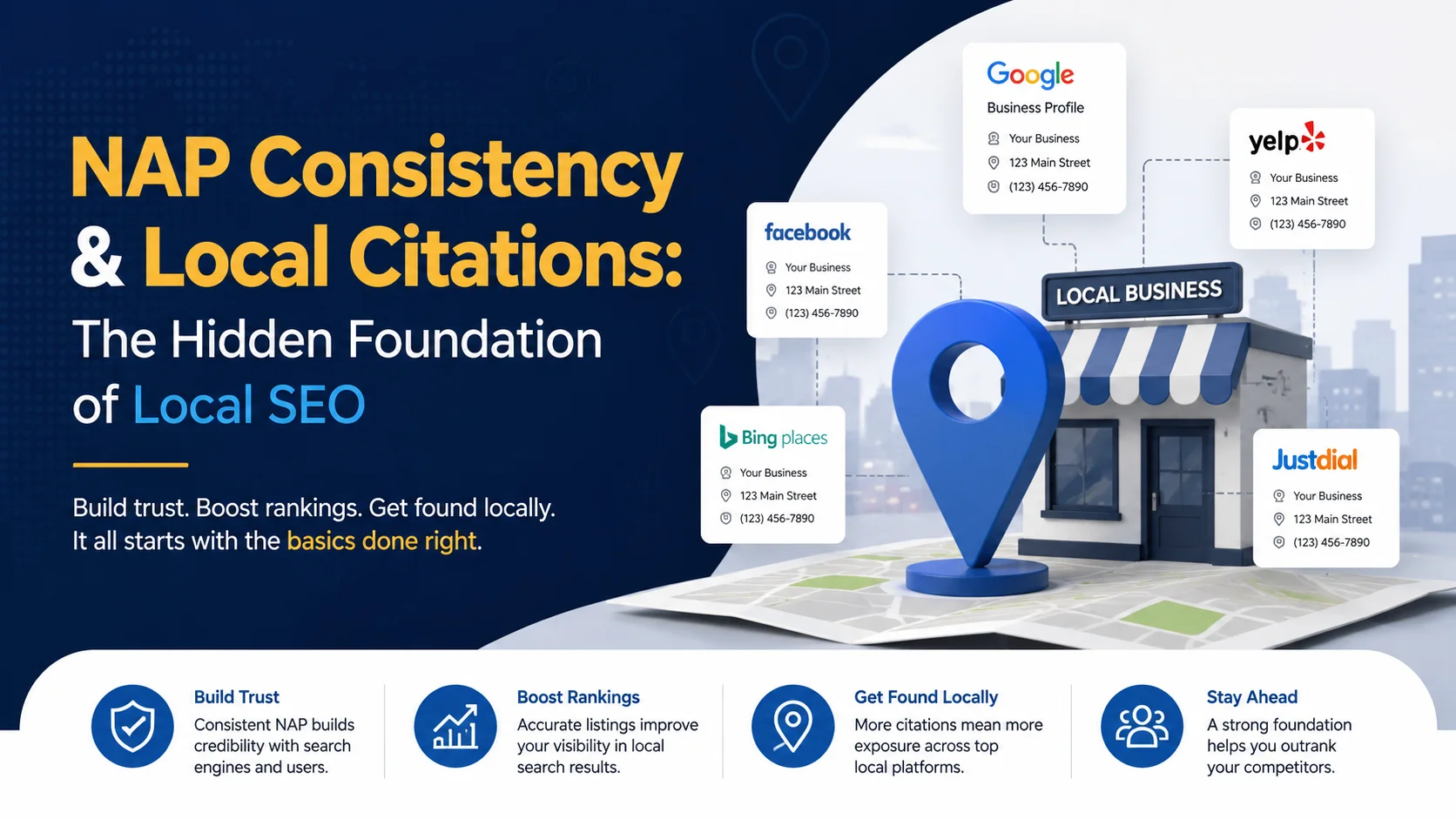
NAP Consistency & Local Citations:
The Hidden Foundation of Local SEO
Why One Wrong Address Can Quietly Destroy Your Google Rankings
A Complete Guide for Indian Local Businesses on Building, Fixing, and Managing Their Online Citation Footprint
Prepared by: Content Strategy Team | Category: Local SEO & Citations | Read Time: ~13 Minutes
Introduction: The Small Mistake That Costs Big
It started with a small detail that seemed completely harmless at the time.
When Suresh registered his automotive repair workshop in Pune back in 2019, he filled in the address on his Google Business Profile as 'Shop 7, Dhole Patil Road, Pune 411001.' A few months later, he listed his business on Justdial — and in a hurry, he typed 'Shop No. 7, DP Road, Pune.' On a local business Facebook group that same year, a member posted about the workshop and someone commented the address as 'Near Dhole Patil Chowk, Pune 411001.' On Sulekha, where a well-meaning family member created a listing on his behalf, it read 'S-7, Dhole Patil Road, Pune, Maharashtra.'
Four listings. Four different versions of the same address. None of them wrong enough to mislead a human customer who already knew where to go. But collectively, they were sending confused, conflicting signals to every search engine and AI tool trying to understand Suresh's business.
The result: despite having one of the most experienced mechanics in the area and a loyal base of returning customers, Suresh's workshop sat stubbornly outside the Google Maps top-three results for automotive searches in his locality — while competitors with newer workshops but cleaner digital footprints appeared ahead of him. When he finally had a digital audit done, the citation inconsistency problem was identified as a primary contributor to his Maps ranking suppression.
This story is not unusual. It is, in fact, the norm for Indian local businesses — most of which have accumulated a scattered, inconsistent, and frequently inaccurate set of directory listings across the web over the years, often without even knowing these listings exist.
This guide is dedicated entirely to this one topic — a topic that every previous post in this series has mentioned in passing but none has fully taught: what local citations are, why NAP consistency is one of the most important and most neglected signals in local SEO, where the dangerous inconsistencies typically hide, and how to systematically find, fix, and build a citation footprint that sends Google and AI tools a clear, confident, trustworthy signal about your business.
Section 1: What Are Local Citations — And What Is NAP?
Defining Local Citations
A local citation is any online mention of your business that includes some combination of your business name, address, and phone number. It does not have to be a dedicated directory listing — a citation can be a mention in a news article, a listing on a business association website, a review on a third-party platform, or an entry in an industry-specific database.
Citations matter for local SEO because they serve as independent verification signals. When Google's algorithm (and, increasingly, AI systems) is deciding which businesses to trust and rank for local queries, it looks for corroboration — does this business appear to exist across multiple independent sources? Are those appearances consistent with each other? A business cited consistently across many reputable sources is treated as more legitimate, more established, and more trustworthy than one that exists only on its own website and GBP.
Think of it this way: if you were trying to verify whether a business was real and trustworthy, and you found the same accurate information about it — the same name, address, and phone number — on twenty different independent websites, you would feel confident it was genuine. If you found twelve different variations of the address and two different phone numbers, you would start to doubt whether any of it was accurate.
What Is NAP?
NAP stands for Name, Address, and Phone Number — the three core pieces of business identity information that citations are built around. NAP consistency refers to the principle that these three pieces of information should be identical across every platform, directory, and website where your business appears online.
Identical means exactly identical — not 'close enough.' The difference between 'MG Road' and 'M.G. Road' and 'Mahatma Gandhi Road' may seem trivial to a human reader, but search engine algorithms and AI systems treat these as different strings of text. Three listings that all refer to the same physical address but use three different formats of that address create genuine ambiguity for automated systems that are trying to match and verify your business's location.
💡 The NAP Consistency Rule — Memorise This
Your business Name, Address, and Phone Number must appear in exactly the same format — character for character, abbreviation for abbreviation — on every platform where your business is listed online.
Decide on your canonical (official) format for each of the three elements and use it without variation everywhere:
- Name: Exactly as registered — no abbreviations, no taglines, no keyword additions.
- Address: Agreed format for building number, street name, locality, city, and PIN code.
- Phone: One primary number, in consistent format (e.g., +91-XXXXX XXXXX everywhere).
Section 2: Why NAP Consistency Is an AI Search Signal — Not Just an SEO Nicety
NAP consistency has been recognised as a local SEO ranking factor for many years. But in 2026, its importance has increased significantly — because AI-powered search tools rely on citation data in a different and more consequential way than traditional search algorithms did.
How Traditional Search Used Citations
In traditional local SEO, citations served primarily as authority signals. The more high-quality, consistent citations a business had, the more authoritative it appeared to Google's local ranking algorithm, and the better it ranked in the map pack. Inconsistent citations mildly confused the algorithm — diluting the signal strength — but the damage was often modest and recoverable.
How AI Search Uses Citations
AI search tools — including Google's AI Overviews, Ask Maps, and AI assistants like Gemini and Siri — use citation data differently. They are not just checking whether citations exist; they are reading them to build a composite understanding of what your business is. When these tools find conflicting information across different sources — different phone numbers, different addresses, different business name formats — they face a fundamental problem: which version is correct?
An AI system that is uncertain about which piece of information is accurate will do one of two things: it will either choose the version that appears most frequently (which may still be wrong), or it will reduce its confidence in recommending the business at all. In an environment where AI recommendations are increasingly zero-sum — where only one or two businesses are named in a generated response — reduced confidence means reduced recommendations. Reduced recommendations means lost customers.
| ✓ Business with Consistent NAP | ✗ Business with Inconsistent NAP |
|---|---|
| AI reads same address across 15+ sources | AI finds 4 different address formats across sources |
| AI confidently matches business to location queries | AI uncertain which location data is accurate |
| AI includes business in 'near me' recommendations | AI avoids recommending — too much ambiguity |
| Trust signal: this business is established and verified | Trust signal: uncertain, possibly outdated or moved |
| Schema data confirms what citations say — double confidence | Schema data contradicts some citations — reduced trust |
Section 3: The Most Dangerous Sources of Citation Inconsistency
Before you can fix your citation profile, you need to understand where inconsistencies typically come from. For most Indian local businesses, the problems originate from one or more of the following five sources.
Source 1: Old Listings Created During Registration or Launch
When a business first opens or registers, listings are often created across multiple platforms in a hurry — sometimes by the owner, sometimes by a CA or registration agent filling in forms. These early listings frequently contain abbreviations, informal names, or address formats that differ from what the business later decides is its official format. They then sit unchanged for years, quietly sending the wrong signals.
Source 2: Listings Created by Third Parties Without Your Knowledge
Many directory platforms — Justdial, Sulekha, Yellow Pages India, IndiaMART, and others — automatically generate business listings from publicly available data. These auto-generated listings may pull information from sources that are themselves outdated or inaccurate. You may have never visited these platforms, yet your business exists on them with information you have never verified or approved.
This is one of the most common and most dangerous sources of citation inconsistency in India — because businesses do not know to look for or fix listings they never created. A full citation audit for most Indian businesses reveals between eight and twenty platforms where some version of their business information exists, the majority of which the business owner has never logged into.
Source 3: Address or Phone Number Changes Over Time
A business that has moved premises, changed its phone number, rebranded, or changed ownership faces a particularly challenging citation situation. Every listing that was correct before the change is now incorrect. And because old listings tend to persist on the web indefinitely — search engines cache them, archive sites preserve them — a single address change can leave a trail of outdated information across dozens of platforms for years unless actively corrected.
Source 4: Informal Mentions and Community Listings
Local Facebook groups, community WhatsApp-sourced websites, colony or society directories, trade association member pages, and local news articles that mention a business can all create informal citations — often with address details typed from memory or copied incorrectly from another source. These informal citations carry less algorithmic weight than structured directory listings, but they still contribute to the overall citation noise that AI systems encounter when researching your business.
Source 5: Abbreviation and Format Variations in Your Own Listings
Even when all your listings were created by you, in good faith, at around the same time — inconsistency creeps in through the natural variation in how we type things when we are in a hurry. 'Bengaluru' versus 'Bangalore.' '#23' versus 'No. 23' versus 'Shop 23.' '+91 98XXX XXXXX' versus '098XXX XXXXX' versus '98XXXXXXXX.' These look like trivial variations to a human eye. To an algorithmic system trying to match and verify data, they are distinct strings.
Section 4: A Real-World NAP Inconsistency Audit — What It Looks Like
To make the problem tangible, here is a real-world example of what a citation inconsistency audit typically reveals for an Indian local business. The business is fictional but representative.
The Business: FreshBrew Coffee Roasters, Koramangala, Bengaluru
FreshBrew is a specialty coffee café that opened in 2021. When they launched, the owner filled in directory listings across several platforms over the course of a few weeks, working quickly between other responsibilities. Here is what a citation audit reveals four years later:
| ✓ Consistent NAP (Google & Official) | ✗ Inconsistent NAP (Directory Listings) |
|---|---|
| Google Business Profile FreshBrew Coffee Roasters 47, 6th Block, Koramangala, Bengaluru 560095 +91-98801 XXXXX freshbrewcoffee.com |
Justdial Fresh Brew Coffee Roasters No. 47, 6th Block Koramangala, Bangalore - 560095 98801 XXXXX (no country code) — |
| Website FreshBrew Coffee Roasters 47, 6th Block, Koramangala, Bengaluru 560095 +91-98801 XXXXX freshbrewcoffee.com |
Sulekha (auto-generated) Freshbrew Coffee 6th Block, Koramangala, Bengaluru +91-80-XXXXXXXX (old landline — disconnected) — |
| Facebook Page FreshBrew Coffee Roasters 47, 6th Block, Koramangala, Bengaluru 560095 +91-98801 XXXXX freshbrewcoffee.com |
Yellow Pages India Fresh Brew Coffee 47, Koramangala 6th Block, BLR 098801XXXXX — |
The inconsistencies above — across just four platforms — include three different formats of the business name, four different address formats, one completely wrong phone number (a disconnected landline pulled from an old source), and multiple missing website URLs. Now imagine this same pattern repeated across twelve to twenty platforms, which is typical for a business that has been operating for three or more years.
This is the citation profile that Google's algorithm and AI search tools are trying to interpret when building their understanding of FreshBrew Coffee Roasters. The confusion is real — and the impact on local search visibility is measurable.
Section 5: The Essential Citation Platforms for Indian Local Businesses
Not all citations are equal. Some platforms carry significantly more authority and are weighted more heavily by Google's local algorithm and AI systems. The table below lists the most important citation sources for Indian local businesses, organised by priority.
| Platform / Directory | Priority Tier | Why It Matters |
|---|---|---|
| Google Business Profile | Tier 1 — Critical | Google's own platform; the single most influential source for Maps, AI Overviews, and Assistant recommendations. |
| Apple Maps (Maps Connect) | Tier 1 — Critical | Primary data source for Siri; rapidly growing importance as iPhone penetration rises in urban India. |
| Bing Places for Business | Tier 1 — Critical | Primary source for Microsoft Copilot and Bing local search; underutilised by most Indian businesses. |
| Justdial | Tier 2 — High | India's largest local business directory; heavily used by Indian consumers and crawled by search engines. |
| Sulekha | Tier 2 — High | Widely used in South India in particular; often auto-generates listings from third-party data. |
| IndiaMART | Tier 2 — High | Critical for B2B and manufacturing businesses; high domain authority, heavily indexed. |
| IndiaBizClub / TradeIndia | Tier 2 — High | Significant authority for trade and industrial businesses in India. |
| Yellow Pages India | Tier 2 — Medium | Older platform with persistent web authority; frequently contains outdated auto-generated data. |
| Facebook Business Page | Tier 2 — Medium | Widely used by Indian consumers to verify businesses; contributes to overall citation footprint. |
| Practo | Tier 3 — Category | Essential for healthcare providers; heavily used by patients searching for doctors, clinics, labs. |
| Zomato / Swiggy | Tier 3 — Category | Non-negotiable for restaurants and food businesses; major source for AI food-related queries. |
| MagicBricks / 99acres | Tier 3 — Category | Essential for real estate agencies and property businesses. |
| Commonfloor / Housing.com | Tier 3 — Category | Important for real estate and property management businesses. |
| UrbanClap / Urban Company | Tier 3 — Category | Home services and personal services businesses should maintain accurate listings here. |
The key insight from this table is the distinction between universal platforms (Tier 1 and 2) that every business needs to be consistently present on, and category-specific platforms (Tier 3) that are essential for some businesses but irrelevant for others. A dental clinic needs to prioritise Practo. A restaurant must have accurate listings on Zomato and Swiggy. A home renovation contractor should be on Urban Company. Identify your category-specific platforms and treat them with the same rigour as the universal ones.
Section 6: Your Step-by-Step Citation Audit and Cleanup Process
Now that you understand what citations are, why they matter, and where problems typically originate, here is a practical, step-by-step process for auditing and cleaning up your citation footprint.
Step 1: Define Your Canonical NAP (Do This First — Everything Else Depends on It)
Before you touch a single listing, decide on the exact, official format of your business name, address, and phone number. Write it down. This is your canonical NAP — the master reference that every listing across every platform will be updated to match.
- Business Name: Use your exact registered business name. No 'Pvt Ltd' if you trade as a shorter name, but be consistent about whichever version you choose. No keyword additions ('Best Bakery in Pune' is not a business name).
- Address: Choose one complete format and commit to it. Include: building/shop number, floor if relevant, street name (spelled out fully, no abbreviations), locality/area name, city (decide: 'Bengaluru' or 'Bangalore' — pick one and use it everywhere), and PIN code.
- Phone Number: Choose your primary contact number and one format. Recommendation: +91-XXXXX XXXXX (country code, space, five digits, space, five digits). Use this exact format on every platform.
Step 2: Find All Your Existing Listings
Search for your business systematically. Use the following queries in Google, one at a time:
- "[Your exact business name]" — finds any page that quotes your name"),
- "[Your phone number]" — finds any listing that includes your number
- "[Your address]" — finds any listing that includes your address
- Your business name + "justdial" / "sulekha" / "indiamart" / "yellowpages"
List every platform where your business appears. Note the URL, the current name/address/phone as listed, and whether you have login access to that platform. This list is your audit inventory.
Step 3: Claim Unclaimed Listings
For every listing you find that you did not create — or where you no longer have login access — go through the platform's business claiming process. Most major Indian directories (Justdial, Sulekha, IndiaMART) have a 'Claim this Business' or 'Are you the owner?' option. This typically involves verifying via OTP to the registered mobile number or email. Once claimed, you control the listing and can update it to your canonical NAP.
Step 4: Update Every Listing to Your Canonical NAP
Work through your audit inventory systematically, one platform at a time. For each listing, update:
- Business name — to your exact canonical name
- Address — to your exact canonical format
- Phone number — to your canonical format with country code
- Website URL — add this wherever the field exists
- Business category — as specific as the platform allows
- Business description — consistent core description across platforms
This is time-consuming but is a one-time investment. Set aside a dedicated half-day or full day, work through the list methodically, and document each correction as you go.
Step 5: Build New Citations on Missing High-Priority Platforms
Once your existing citations are cleaned up, identify the Tier 1 and Tier 2 platforms from Section 5 where your business does not yet appear and create accurate, complete listings. Prioritise Google Business Profile, Apple Maps, and Bing Places — these are non-negotiable for AI assistant visibility. Then work through the universal Indian directories and your category-specific platforms.
Step 6: Set a Quarterly Review Process
Citation management is not a one-time task. New auto-generated listings appear. Old listings get re-populated with outdated data by data aggregators. Platforms update their data from third-party sources. Set a quarterly reminder to re-run your Google searches for your business name and phone number, check for any new or re-corrupted listings, and update them to your canonical NAP.
Section 7: Case Study — The Pune Workshop That Recovered Its Rankings
Let us return to Suresh and his automotive workshop in Pune — the business we introduced at the beginning of this guide.
The Full Audit Picture
When a comprehensive citation audit was conducted for Suresh's workshop, the following was found across seventeen separate online platforms:
- Four different formats of his business name ('Suresh Auto Works,' 'Suresh Auto Workshop,' 'Suresh Auto Services,' and 'Suresh Motors').
- Six different address formats — some missing the shop number, some using 'DP Road' instead of 'Dhole Patil Road,' and one using an old PIN code from before a postal boundary change.
- Three different phone numbers — his current mobile, an old mobile he no longer used, and a landline that had been disconnected.
- His Google Business Profile, which he had set up carefully, was being undermined by the conflicting data on the other sixteen platforms.
The Cleanup
Over a single dedicated weekend, Suresh and his nephew worked through every listing. They defined the canonical NAP as: 'Suresh Auto Works | Shop 7, Dhole Patil Road, Camp Area, Pune 411001 | +91-98XXX XXXXX.' They claimed six previously unclaimed listings, corrected twelve existing listings, and created three new listings on Tier 1 platforms where the workshop had no presence. They also added their website URL to every listing that had a field for it.
The Outcome
Within approximately eight to ten weeks of completing the citation cleanup, Suresh's workshop moved into the Google Maps top-three results for 'car mechanic Dhole Patil Road' and 'automobile workshop Camp Pune' — search terms it had previously not appeared for in the map pack at all. Phone calls from Google Maps increased noticeably over the following month. Suresh attributes a significant portion of this improvement directly to the citation cleanup, noting that nothing else about his business or digital presence had changed during that period.
💡 The Core Lesson from Suresh's Story
Citation inconsistency is a silent suppressor. It does not announce itself. Your website works fine. Your GBP looks complete. Your reviews are good. But if the seventeen other places on the web that mention your business are all saying something slightly different about who you are and where you are, Google and AI tools cannot build a confident, unified picture of your business — and a business they are not confident about is one they are reluctant to recommend.
The fix is not technical or expensive. It is methodical, one-time work — and the return, in terms of local search visibility, is disproportionate to the effort involved.
Conclusion: Build on Solid Ground
Every guide in this series — on AI visibility, on GBP optimisation, on reviews, on schema markup, on conversational content, on voice search — has been built on an assumption: that the foundation beneath those strategies is solid. That the basic information about your business — your name, your address, your phone number — is accurate, consistent, and trustworthy wherever it appears on the web.
If that foundation is cracked — if different corners of the internet are quietly telling different stories about who you are and where to find you — then the impact of every other optimisation you make is diminished. Strong content reaches fewer people when your citation signals are confused. A well-optimised GBP performs below its potential when it is contradicted by inconsistent directory listings. Schema markup confirms information that other sources are simultaneously contradicting.
Citation consistency is not the most glamorous aspect of local SEO. It does not have the immediacy of a new Google feature or the excitement of an AI capability. But it is the bedrock — the thing that makes everything else work as it should. And for most Indian local businesses, it is also the most neglected, most fixable, and highest-return investment that a few hours of focused attention can produce.
Do the audit. Fix the inconsistencies. Build on solid ground. Everything else you have learned in this series will perform better for it.
📋 Your Citation Audit Action Plan — This Weekend
- Write down your canonical NAP right now: exact business name, full address in one agreed format, primary phone number with +91 country code.
- Search Google for your business name in quotes and list every platform where it appears.
- Search Google for your phone number in quotes and add any new platforms to your list.
- Claim any unclaimed listings on high-priority platforms using the owner verification process.
- Update every listing to your canonical NAP — name, address, phone, website URL, category.
- Create new listings on any Tier 1 or Tier 2 platforms where you are currently absent.
- For your category, identify and update/create listings on the relevant Tier 3 platforms (Practo, Zomato, Urban Company, etc.).
- Set a quarterly calendar reminder to re-audit your citation footprint and correct any new inconsistencies.